

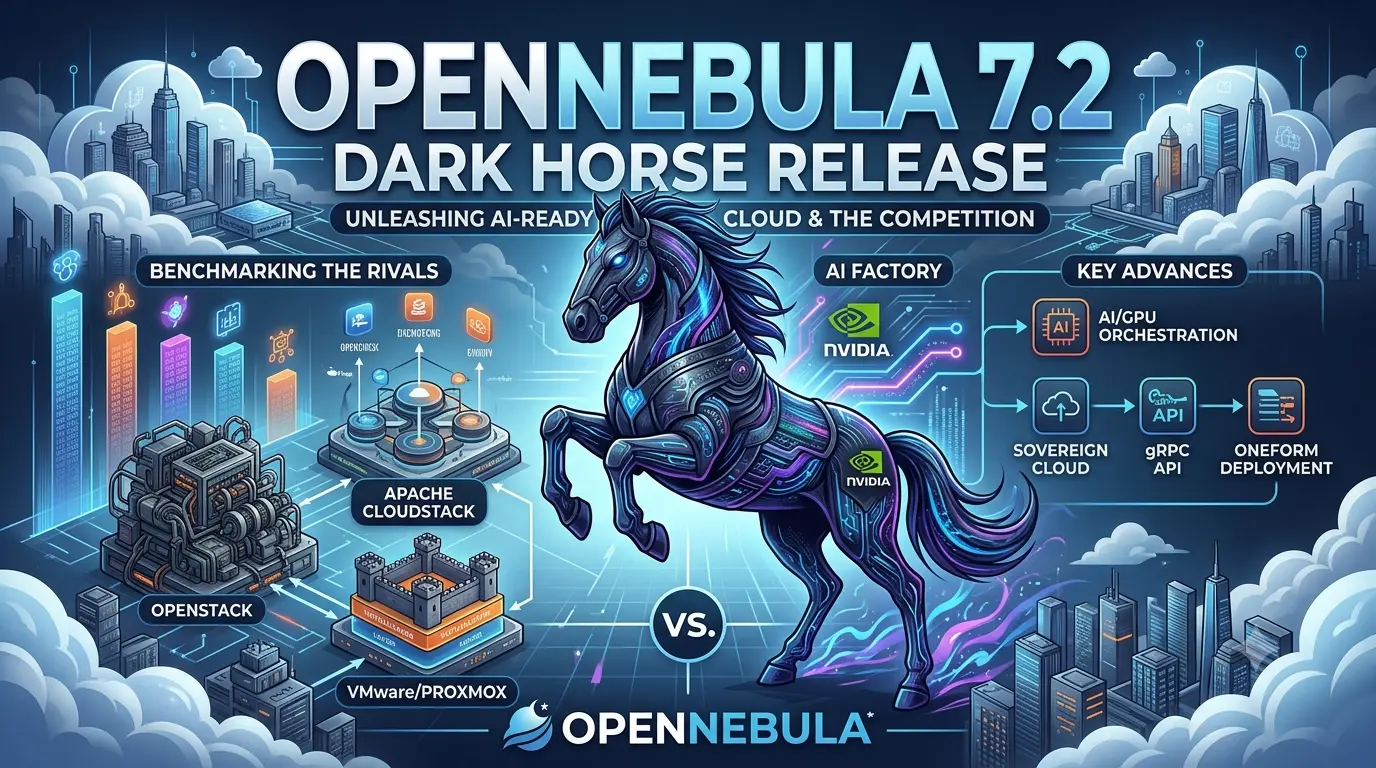
OpenNebula 7.2 introduces a single-process control plane, declarative cluster provisioning via OneForm, and native NVIDIA Fabric Manager integration for GPU-dense AI workloads. It occupies a unique architectural middle ground: lighter than OpenStack, stronger multi-tenancy than Proxmox VE, and more modern API surfaces than Apache CloudStack. For teams exiting VMware or building sovereign AI factories, OpenNebula 7.2 reduces Day-2 operational overhead to a 1-2 engineer footprint.
Key takeaways:
- Control plane runs on a single 4 vCPU VM – no message bus, no etcd cluster.
- OneForm YAML promotes pilot clusters to production without pipeline drift.
- NVLink-aware scheduler places distributed training jobs on coherent GPU fabric.
- gRPC streaming API replaces legacy XML-RPC for modern automation.
- Enterprise RBAC and quotas out of the box, no custom scripting required.
The VMware Transition: Engineering Context
Broadcom’s acquisition of VMware triggered a forced re-evaluation of private cloud strategy across the industry. Perpetual licenses converted to subscription, support tiers consolidated, and pricing increased 2-5x for many accounts. Engineering teams now face a practical constraint: migrate off vSphere without inheriting a new operational burden.
The evaluation criteria have shifted. Teams are no longer comparing feature checklists – they are comparing total cost of ownership measured in engineer-hours. A platform requiring five dedicated operators to maintain its control plane is a non-starter for most mid-market and enterprise IT shops. This is where OpenNebula 7.2 enters the conversation.
It will address this constraint with a control plane that runs on a single VM and a feature set that covers the actual requirements of modern private clouds: multi-tenancy, GPU orchestration, and declarative edge provisioning.
OpenNebula 7.2 Architecture: Single-Process Control Plane
OpenNebula 7.2 runs its entire management stack – scheduler, provisioning drivers, API gateway, and database layer – in a single frontend process. Node agents are stateless, lightweight daemons that communicate over a secure gRPC channel. There is no RabbitMQ, no etcd cluster, no fleet of micro-services to version-pin and upgrade independently.
This design yields measurable operational advantages:
- Cold start to API readiness in under 30 seconds on modest hardware.
- Upgrade procedure: replace binary, restart service – no schema migrations across distributed components.
- Failure domain limited to the frontend VM; node agents continue serving workloads during control-plane restarts.
- Database backend (SQLite default, MySQL/PostgreSQL optional) is the only external dependency.
Contrast this with OpenStack, where a routine control-plane upgrade touches Keystone, Nova, Neutron, Cinder, Glance, Placement, and their respective databases. OpenStack remains the correct choice for massive multi-region telco deployments that require its specific project isolation model. For single-region private clouds, the operational tax is disproportionate.
OpenNebula 7.2 achieves this simplicity without sacrificing enterprise features because the scheduler, provisioning engine, and API gateway share in-process state instead of coordinating over a message bus. This architectural choice is why OpenNebula 7.2 stays lightweight while OpenStack grows a message bus.
Key Features of OpenNebula 7.2
OneForm: Declarative Cluster Provisioning
OneForm is a YAML-based cluster specification that defines hosts, networks, datastores, and marketplace appliances in a single file. The frontend consumes the spec and converges the cluster state idempotently. This eliminates the configuration drift that plagues imperative UI clicks or bespoke Terraform providers.
A minimal OneForm example defines three KVM hosts, a VXLAN overlay, and a Ceph datastore in ~60 lines. Applying it takes minutes. Promoting a pilot to production means committing the same YAML to Git – no separate pipeline required.
OpenNebula 7.2 extends OneForm with marketplace integration, allowing entire application stacks (Kubernetes, Kafka, databases) to be deployed alongside the infrastructure layer.
Native NVIDIA Fabric Manager & NVLink Integration
OpenNebula 7.2 integrates NVIDIA Fabric Manager directly into the scheduler. The scheduler maintains a real-time topology map of NVLink and NVSwitch interconnects across the cluster. When a training job requests 8 GPUs with NVLink connectivity, the scheduler places the allocation on a coherent fabric domain automatically – no manual affinity rules, no custom resource definitions.
Multi-Instance GPU (MIG) slicing is exposed as a first-class consumable resource. An A100 can be partitioned into seven 10 GB instances, each schedulable independently with guaranteed memory and compute isolation. This capability is critical for multi-tenant AI factories where fractional GPU sharing must be enforceable, not advisory.
OpenNebula 7.2 GPU orchestration is not a bolt-on – it is core to the placement engine, which means fabric awareness applies to every scheduling decision, not just labeled GPU nodes.
gRPC Streaming API
The legacy XML-RPC endpoint is deprecated. The new gRPC surface provides unary calls for CRUD operations and server-side streaming for watch semantics (resource state changes, metric updates, log tails). Client libraries exist for Go, Python, and TypeScript. Latency for a VM create call drops from ~800 ms (XML-RPC) to ~120 ms (gRPC) on identical hardware.
Sovereign Cloud Hardening
Default deployment now enforces mutual TLS between frontend and node agents, encrypts the internal message bus, and enables audit logging to syslog/ELK-compatible endpoints. Tenant isolation uses Linux namespaces and cgroups v2 with kernel-level resource quotas. These settings are active on install – no post-deployment hardening checklist required.
AI Factory Workloads: Why OpenNebula 7.2 Wins on GPU Fabric
Distributed training workloads are sensitive to interconnect topology. A job spanning 8 GPUs across two servers connected by PCIe gen4 will saturate the bus and stall on gradient all-reduce. The same job on an NVLink domain completes 30-40% faster because peer-to-peer transfers bypass the CPU root complex entirely.
OpenNebula 7.2 solves this by exposing the physical NVLink topology to the scheduler as a first-class resource attribute. The scheduler understands switch hierarchy, link counts, and bandwidth per link. When a tenant requests a coherent 8-GPU domain, the placement engine filters hosts at fabric granularity, not just PCIe bus.
MIG slicing compounds the value. A single A100 partitioned into seven MIG instances can serve seven inference tenants simultaneously. OpenNebula 7.2 enforces memory and compute quotas at the hardware level via the NVIDIA driver – no hypervisor mediation required.
This level of GPU fabric awareness is absent from OpenStack (manual placement policies only), CloudStack (PCI passthrough only), and Proxmox (mediated devices experimental). For AI factory operators, it is the difference between a platform that runs training jobs and a platform that optimizes them. This gap is exactly why OpenNebula 7.2 is being adopted in sovereign AI clusters.
Technical Comparison: OpenNebula 7.2 vs. Alternatives
The table below evaluates four platforms on criteria that directly impact Day-2 operations.
| Criterion | OpenNebula 7.2 | OpenStack | Apache CloudStack | Proxmox VE |
|---|---|---|---|---|
| Control Plane Architecture | Single-process frontend + stateless agents | Distributed micro-services (15+) | Java management server + agents | Single-node or HA pair (pve-manager) |
| API Surface | gRPC streaming + REST gateway | REST (Keystone-authenticated) | REST + legacy API | REST (pve-api) |
| Native GPU / NVLink Scheduling | Fabric Manager integrated, NVLink-aware, MIG native | Manual via placement policies, no fabric awareness | PCI passthrough only | PCI passthrough + mediated devices (experimental) |
| Multi-Tenancy Model | Hierarchical groups, RBAC, quota, chargeback | Projects, domains, quotas | Domains, accounts, quotas | Pools + basic ACLs (no hierarchical quotas) |
| Edge / Remote Cluster Orchestration | OneForm + federated zones | DCN / Cells (complex) | Zone-based (legacy) | Not applicable |
Where Each Platform Fits
OpenStack remains the reference architecture for massive-scale, multi-region service provider clouds. Its project/domain isolation model and bare-metal provisioning (Ironic) are unmatched at that scale. The trade-off is a control plane that demands a platform team.
Apache CloudStack provides a stable, VMware-like experience for traditional virtualization workloads. Its Java management server is mature but the ecosystem has not kept pace with Kubernetes-native workflows or modern GPU orchestration. It is a valid choice for lift-and-shift VMware migrations that do not require AI/ML capabilities.
Proxmox VE excels at small-to-medium homogeneous KVM clusters. Its integrated backup, replication, and Ceph management are best-in-class for that scope. It lacks hierarchical multi-tenancy, chargeback, and programmatic edge orchestration – gaps that appear when the environment grows beyond a single administrative domain.
OpenNebula 7.2 targets the gap between Proxmox simplicity and OpenStack scale: advanced multi-tenancy, native GPU factory orchestration, and declarative edge provisioning – all within a control plane one engineer can own.
Migration Path: vCenter to OpenNebula 7.2
The vCenter import tool connects to the vSphere API, enumerates VMs, networks, and datastores, and recreates the inventory in OpenNebula. Disks are converted via qemu-img on the fly (VMDK to QCOW2/RAW). Network mappings (port groups to VXLAN/VLAN) are defined once in the import profile.
Typical migration window for a 50-VM cluster: 2-4 hours of cutover time with cold migration, near-zero with live storage migration on shared storage. Storage driver re-mapping (VMFS to Ceph/LVM/NFS) is the only manual step for non-standard configurations.
Adopt OpenNebula 7.2 if:
- You need enterprise multi-tenancy (RBAC, quotas, chargeback) without a platform team.
- You run GPU-dense AI/ML workloads requiring NVLink-aware scheduling and MIG slicing.
- You operate edge or sovereign sites requiring declarative, reproducible cluster provisioning.
- You are exiting VMware and want a control plane that runs on a single VM.
Defer if:
- You require OpenStack’s multi-region, bare-metal, or NFV-specific feature set.
- Your workload is purely traditional virtualization on a single homogeneous cluster – Proxmox VE is simpler.
- You have an amortized OpenStack investment with a trained platform team.
Recommended Resources & Internal Links
External References
OpenNebula 7.2 Release Notes – https://docs.opennebula.io/7.2/software/release_information/release_notes/whats_new/
NVIDIA Fabric Manager Documentation – https://docs.nvidia.com/datacenter/cloud-native/fabric-manager/
OneForm Configuration- https://docs.opennebula.io/stable/operations/oneform/
gRPC Integration – https://docs.opennebula.io/7.2/product/control_plane_configuration/large-scale_deployment/grpc/
Internal Links
vCenter Server Simulator Ultimate Guide
VMware Cloud Foundation 9.1: What Actually Changed
Proxmox VE 9 + PBS 4.0: The Most Powerful Open-Source Virtualization Stack Yet
VMware vSphere 9.0 Revealed: Why Staying on Old Versions Could Destroy Performance
