Category: Virtualization

1

Using Network Partitioning (NPAR) in VMware ESXi

Data Center design is changing year by year, before virtualization all servers was physical and data centers were full of devices and cables. Virtualization helped to make data centers smaller and consolidate different workloads in same hardware. Hardware technologies are also helping to achieve this goal. Network Partitioning (NPAR) is one of hardware technologies which helping to reduce cabling, switch devices and use all I/O capacity in data centers. What’s Network Partitioning (NPAR)? NPAR is an operating system and switch agnostic technology that allows customers to reduce the number of I/O adapters required to support different application workloads. Traditional best practices require separate LAN or SAN connections for different aspects of application workloads. Converged Network Adapters already support widely used SAN protocols like Fibre Channel over Ethernet (FCoE) and iSCSI, administrators can already reduce the number of adapters needed for separate protocols, including separate Fibre Channel and Ethernet adapters. With NPAR, these adapters can now partition their network bandwidth further into multiple virtual connections, making one dual-port adapter appear as eight adapters to the operating system for use by the applications. This greatly simplifies the physical connectivity to the server, reduces implementation time, and lowers the acquisition cost of the...

0

What’s New in Proxmox VE 6

Proxmox Server Solutions GmbH, developer of the open-source virtualization management platform Proxmox VE, today released its major version Proxmox VE 6.0. The comprehensive solution, designed to deploy an open-source software-defined data center (SDDC), is based on Debian 10.0 Buster. It includes updates to the latest versions of the leading open-source technologies for virtual environments like a 5.0 Linux kernel (based on Ubuntu 19.04 “Disco Dingo”), QEMU 4.0.0, LXC 3.1.0, Ceph 14.2 (Nautilus), ZFS 0.8.1, and Corosync 3.0.2. Proxmox VE 6.0 delivers several new major features, enhancements, and bug fixes.

Oracle Secure Global Desktop 0

Oracle Secure Global Desktop 5.5 for Secure Remote Access to Data and Applications in the Cloud and On Premises

Oracle Secure Global Desktop (SGD) is a web-based solution that allows users to remotely access data and applications in a data center or the cloud. It provides administrators with a single pane of glass to manage secure access to resources with a completely air-gapped, highly secure connection between the client and the data and applications accessed, allowing complete control of which user can access which application and the server it runs on, all through a convenient web interface.
1

Oracle Linux Virtualization Manager

This new server virtualization management platform can be easily deployed to configure, monitor, and manage an Oracle Linux Kernel-based Virtual Machine (KVM) environment with enterprise-grade performance and support from Oracle. Red Hat did it and developed Red Hat Enterprise Virtualization Manager based on the open source oVirt project .

2

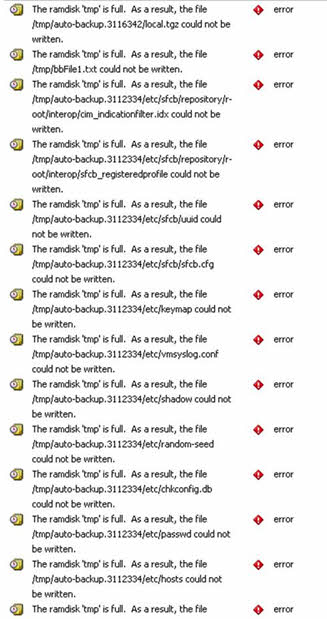
The ramdisk ‘tmp’ is full – VMware ESXi 6.x on HPE ProLiant

We are using HPE ProLiant servers in our virtual environment to delivering different services to our customers. VMware ESXi has been installed on all servers as Hypervisor. You know that each vendor has customized image that includes VMware ESXi, drivers and management tools. It seems, there is an issue on HPE Agentless Management (AMS) on latest ESXi image.