Veeam ONE 9.5 Update 4
Veeam has released update for Veeam ONE 9.5. The new update came with new features and improvements. Veeam ONE 9.5 update 4 is available for download from January 22, 2019 on Veeam website.
Veeam has released update for Veeam ONE 9.5. The new update came with new features and improvements. Veeam ONE 9.5 update 4 is available for download from January 22, 2019 on Veeam website.
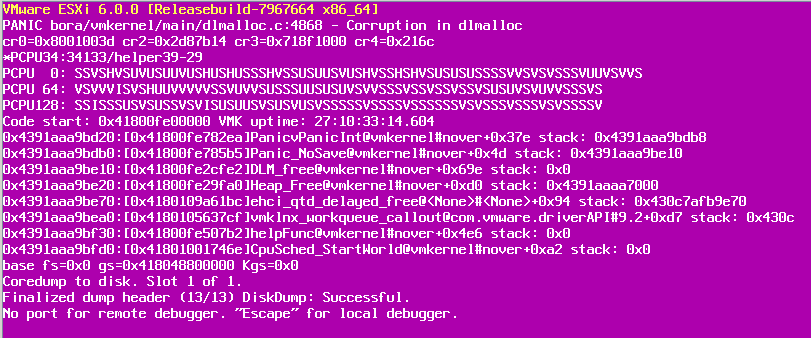
“Corruption in dlmalloc” issue occurs because multiple esxcfg-dumppart threads attempt to free memory which has been used for configuring the dump partition. Thread A checks if there are entries to be freed and proceeds to free them, while within the same time frame, Thread B is also attempting to free the same entries.
Based on VMware KB2147888, this issue is resolved on ESXi 6 U3. But why issue is happening on ESXi 6 U3 or ESXi 6.5 U1 when they are installed on HPE ProLiant servers?
I guess, you know the instruction but let’s quick review. You can export virtual machines via some different tools such as vSphere Client, vSphere Web Client and others. All administrators do it today and familiar with OVA and OVF. It’s possible to export small virtual machines via vSphere Client, vSphere Web Client, PowerCLI. If you want to export virtual machine with 200~300 GB virtual disks (Thin or Thick), there is serious problem, just make sure that you have enough free space. But did you try to export big or monster VM as OVA or OVF?
These days, everyone knows what’s Cloud Computing and cloud based services are using for speedup deployment of organizations services. Operating System Level Virtualization or Containers helping system architectures and administrators to achieve the goals. There are many implementations for containers that today, those methods are compatible with different hardware architectures and operating system.
You may know that Unix has OS Level Virtualization from past years and this technology is very older than other virtualization such as Full Virtualization or Paravirtulization.
Full Virtualization (VMware ESXi, Hyper-V) and Paravirtualization (Xen, UML) provides different guest OS but there is no way to use different guest OS when you are using containers. Of curse, some solutions are under development.
RAW Device Mapping (RDM) is one of oldest VMware vSphere features which introduced to resolving some limitation on virtualized environments such as virtual disks size limitation and deploying services top of fail-over clustering services.
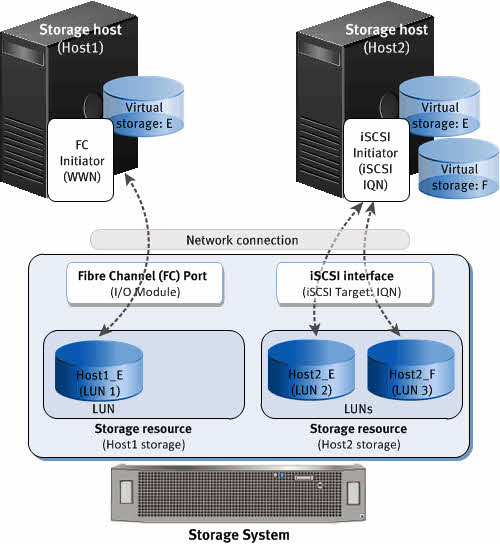
You can use a raw device mapping (RDM) to store virtual machine data directly on a SAN LUN, instead of storing it in a virtual disk file. You can add an RDM disk to an existing virtual machine, or you can add the disk when you customize the virtual machine hardware during the virtual machine creation process.